It's time to let you know our shortlist for the BHO photography competition in May.
This month there was a shortlist of three for the judges to ponder and argue over. Eventually we chose a winner, but the two runners-up (in no particular order) were Castle Rising, by wazman27:
The judges thought that the framing of the picture, through the gateway, was very effective in this photograph. The sense of menace, or at least authority, perhaps conveys what the castle's builders wanted to achieve in those who approached it.
Our other runner-up is rather different in tone, the Peterborough Lido by uplandswolf (who has featured several times in this blog before!):
Looking again at this photo just now, a colleague remarked upon the almost Palladian classicism of the structure. The foreground gardens also have a rather formal feel. None of this seems to detract from the festive tone of the photograph.
Our winner is not quite so festive, the Ossuary at St Leonard's Church in Hythe, by Alan Denney:
Congratulations to Alan for this powerful picture, which will be reminding us our mortality for the next month on the BHO homepage. Few ossuaries have survived in England and, as one of the judges remarked, "it reminds us that local history isn't just about buildings, but also about the people who lived in or built them".
Please do keep your photos coming to the BHO group. We've been very much enjoying looking through them.
British History Online is the digital library containing some of the core printed primary and secondary sources for the medieval and modern history of the British Isles.
Wednesday, 26 June 2013
Monday, 10 June 2013
Chris Dyer on RCHME, Northants
British History Online recently published the six inventory volumes for the county of Northamptonshire. To help to put these volumes in context, Professor Chris Dyer has kindly written a guest blog post explaining their importance. Chris Dyer is Emeritus Professor of Local and Regional History at the University of Leicester, and so is the perfect person to introduce these volumes. Professor Dyer writes:
"The inclusion of the Northamptonshire volumes of the Royal Commission on Historical Monuments, England on British History Online will be welcomed by anyone interested in Northamptonshire, but also in the study of many aspects of the material evidence for the history of the English countryside. When they appeared these volumes marked a high point in the work of the Royal Commission. There were volumes on historic buildings, which was the traditional strength of the RCHME's earlier county inventories, but these were more inclusive and systematic than in the early volumes, because village plans were included, with the older buildings marked, and accompanied by brief descriptions of ordinary houses and cottages, and occasional plans and photographs. Larger houses and churches, the usual subjects of surveys of local architecture, received full treatment as well. All of this was thoroughly researched, with documentary background studies as well as scholarly architectural analyses.
The great innovation and achievement of the Northamptonshire volumes however, is to be observed in the volumes devoted to archaeological sites. Air photograph evidence of field boundaries and settlement sites, mainly of the iron age and Romano-British period, were transcribed on to modern maps, and for the medieval period hundreds of sites marked by earthworks were carefully planned and analysed. They included the famous deserted medieval village sites, and the remains of villages that still survived but had once been much larger. These had only been identified as sites 30 years or so before the Royal Commission planned them. Part of the medieval rural landscape were the fields, visible as ridge and forrow, and some examples of these survivals were also planned. There was also a great variety of sites and features : park boundaries, moated sites, fishponds, pillow mounds from former rabbit warrens, sites of water mills and the mounds on which windmills had stood. Any past activity which involved digging into the earth and making heaps left indelible traces for the researchers of the RCHME to discover. As the work progressed the plans grew ever more sophisticated, and the interpretations of the meaning of the sites became more accomplished. To give one example of the lessons learned from preparing these volumes, post medieval garden earthworks were recognized and planned in detail, and researchers all over the country realised that the expanses of mounds and ditches that had puzzled them suddenly became explicable. Anyone interested in the formation and decline of rural settlement, landscape history, and aristocratic manipulations of the landscape will find important source material in these volumes. They also mark a chapter in the intellectual history of the study of the rural past. They are finally a sad comment on the philistine treatment of the heritage, because not long after these volumes were completed, instead of declaring the intention of carrying out similar studies of the other English counties, the Royal Commission was merged with English Heritage, and ceased to compile inventories."
Chris Dyer
Wednesday, 29 May 2013
Roman Inscriptions in the RCHME
Over the last couple of months we have published two volumes about Roman remains in England: Roman London and Eburacum, Roman York. These have been part of our current digitisation of the Royal Commission on Historical Monuments inventory series for England.
This subject matter is somewhat unusual for British History Online, although we do have similar material elsewhere, as in the Victoria County History volume for Oxfordshire, Volume 1, and as part of the RCHME we will soon be adding a volume on Iron Age and Romano-British monuments in the Cotswolds. But these two latest RCHME volumes have been a bit of a challenge to digitise because of the large number of inscriptions they contain.
Roman writing did not contain such useful things as spaces between letters, punctuation or differences of case. If you owned a book yourself then you could mark it up for reading yourself, to make things easier. Obviously this couldn't be done with inscriptions, so there was a tendency to add some former of marker between words to make things easier for the reader; here it is done with a mid dot in a dedication tablet from York:
Elsewhere in Roman inscriptions covered by the RCHME a leaf or other symbol is used. Notice that this still doesn't make the inscription very easy to read: words can spill over onto the next line without any indication that they are doing so, as in the name HIERONYMIANVS above; also, like text messages today, Roman inscriptions tend to be highly abbreviated. Fortunately the RCHME editors have painstakingly transcribed, and then translated, the inscriptions for us, with abbreviations expanded. Here is the above:
DEO ▵ SANCTO
SERAPI
TEMPLVM ▵ A SO
LO FECIT
CL(AVDIVS) ▵ HIERONY
MIANVS ▵ LEG(ATVS)
LEG(IONIS) ▵ VI ▵ VIC(TRICIS)
'To the holy god Serapis, Claudius Hieronymianus, legate of the Sixth Legion Victorious, built this temple from the ground.'
The editors then give us quite a lot of information about who this Claudius Hieronymianus was:
"Claudius Hieronymianus is identified (Prosopographia Imperii Romani, 2nd ed., II, 206, no. 888) with a vir clarissimus of this name involved in a judgment by Papinian about a will (Ulpian, Digest, 33, 7, 12, 40) and with the praeses of Cappadocia whom Tertullian (ad Scap. 3) mentions at the turn of the 2nd and 3rd centuries as persecuting Christians after his wife's conversion..."
Thanks to the efforts of the RCHME editors for these volumes, there is a wealth of information of this type - photographs, transcriptions and translations - now available to all.
Monday, 20 May 2013
April photo competition winner
For this month's competition the voting among my colleagues gave us a shortlist of three. In no particular order the two runners-up were:
Tudor Barlow's picture of the cloisters at Gloucester Cathedral
This will be a familiar setting to many but the light in this photograph is evocative. The bright light of the open doorway at the end of the cloisters conveys just the numinous effect that Gothic architecture, presumably, aspires to achieve.
Our other runner up was Disused Slate Mine by stephen bolton1. A photo which I find gritty and melancholy but also eerie - or, if you like, earthy and unearthly at the same time.
After discussion, however, we chose as our winner, Little Moreton Hall by alan tunnicliffe
Like Gloucester Cathedral, this a well known setting, but the photograph is quite unsentimental, perhaps because of the tripartite sky: part lowering, part blue and part irradiated. The context of the house seems to be in harmony with the building, both being somewhat overgrown and chaotic.
Everyone is welcome to add their photos the the British History Online group on Flickr. We are picking our favourite every month in order to celebrate our 10th anniversary. The winning photo will, with permission, appear on the BHO homepage.
Thursday, 25 April 2013
March photo competition winner
Our photo competition is ongoing through the summer, when we will be celebrating British History Online's 10th anniversary. As with last month, a great variety of images were added our BHO Flickr group.
This month we shortlisted three, not because the quality of the others was low but because of the way the voting broke down (staff of IHR Digital vote for their favourites, which then produces a cut-off point for the shortlist). Members of the BHO Working Group then met to discuss the shortlist and choose a final winner.
Again, the shortlisted photographers have kindly sent us copies of their photographs and permission to post them here.
Our two runners-up, in no particular order, were joycemacadam's Scotney Castle LR:
The judges admired the composition of this photograph, with the inclusion of quite a lot of surroundings giving pertinent information about the building's context.
Secondly we have Bewcastle Ancient Cross by karenwithak:
This was an interesting picture, the ancient cross somewhat out of place among the more conventional gravestones, and yet expressing the same commemorative purpose.
After much discussion, we chose as April's winner Derelict signal box in Stamford, by uplandswolf.
Derelict signal box will appear on the BHO homepage gallery for a month.
Keen readers of this blog may remember that uplandswolf was a runner-up in last month's competition, so congratulations again to him. The judges like the unusual and dilapidated subject, a timely reminder of our industrial heritage, alongside the just-visible modern railways station. It turns out that there is an online database of signal boxes, from which you can find that, for example, the Stamford example was built in 1893.
Thursday, 21 March 2013
Image Copyright: An Introduction (2)
Our Permissions Controller for the digitisation of the Royal Commission on Historical Monuments of England, Rachael Lazenby, has written an introductory guide to copyright for images, drawing on her experience on this project and on other work that she has done. Part one of Rachael's guide appeared here; the rest of the guide is below.
(5)
(1) This link will redirect to information on the European memorandum of understanding on orphan works http://www.ifrro.org/content/i2010-digital-libraries retrieved on 22/2/2013.
(2) http://www.copyrightservice.co.uk/copyright/p01_uk_copyright_law retrieved on 22/2/2013
(3) The difficulties of dealing with such issues are discussed in these articles on policing the internet: http://www.bbc.co.uk/news/technology-17111041 retrieved on 22/2/2013
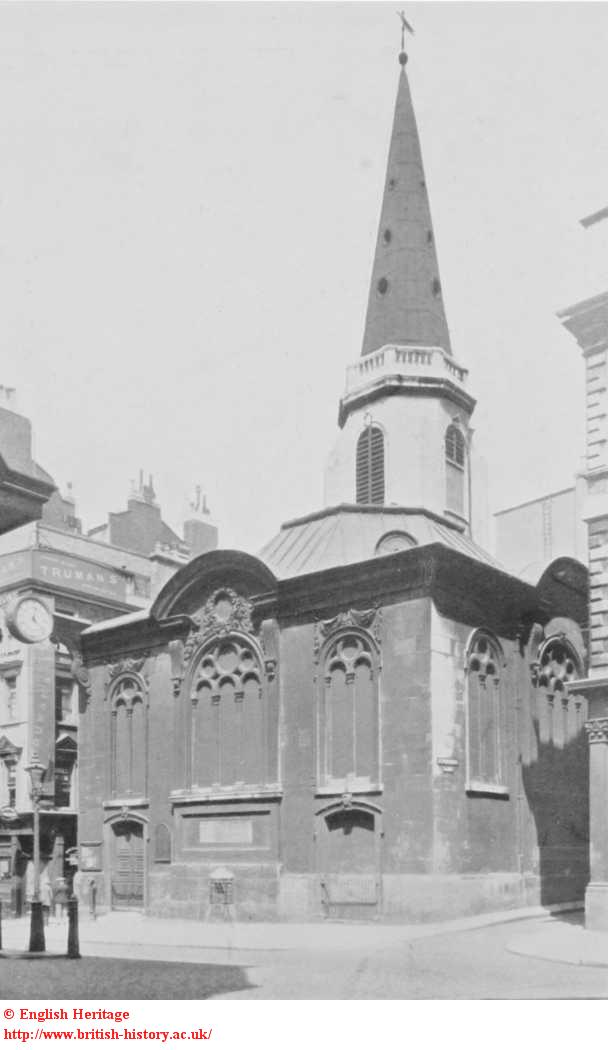
(5) St Swithin’s Church London Stone. This is a Wren church destroyed in the Blitz and not restored.
Copyright and images - an introductory guide, part 2
Rachael Lazenby
Identifying copyright holders, orphan works and due diligence
Frequently
publishers will include images which have appeared in other
publications. The modern convention is to include a caption with the
image which makes it very clear who the copyright holder is and who
should be approached for permission to reproduce an image. However, the
older the publication, the more likely it is that such information will
not be found in a caption. The RCHME volumes, the earliest of which date
from 1913, contained copyright holder information in a variety of
places. This included the illustration lists, footnotes, and the
preliminary materials of the texts as well as in illustration captions.
When considering using images from older works it is advisable to check
in all these places for information on the copyright holder if the
original publisher no longer exists or does not retain rights
information on older publications. Internet searches, local history
societies and local museums may also be able to help in establishing the
copyright status of historical images.
Inevitably
there were some images included in the original RCHME volumes whose
owners could not be traced. Such images are known as orphan works.
Different organisations take different stances on how to approach such
images and every organisation will have advice on what constitutes due
diligence in attempting to establish a copyright holder.(1) A record
should be kept of all efforts made in trying to trace the current rights
holder.
Crown Copyright
Crown
Copyright applies to images produced by certain UK government bodies
and lasts for 50 years. The National Archives has a very informative section on this topic, including a list of bodies whose images now fall
under Crown Copyright. Many
images which are protected by Crown Copyright can be used if a link
appears with the image directing the reader to a ‘click-to-use’ licence.
Fair use and Enforcement
So
far I’ve tried to avoid distinguishing between reproducing images for a
limited circulation (such as a dissertation) and a wide circulation
(such as a paper published in a journal). Theoretically copyright law
covers any reproduction of a work regardless of the circulation or the
commercial value of the work. Of course in practical terms the greater
the commercial value of an image the higher the likelihood that the
copyright holder may take legal action to prevent or punish any
unauthorised use of their image.
Fair
use is a concept which enables students and researchers to provide
examples and quotations of other people’s works in essays and papers
without first obtaining permission from the originator. Generally
speaking quotations tend to pose fewer problems than images and
providing they appear in the body of a text and for educational,
critical or journalistic purposes, they can be used without express
permission. Most educational institutions and publishers have a legal
team who will be able to advise on any concerns you may have about
reproducing images. In addition universities will often provide guidance
on matters of copyright in student handbooks.
It
is important to note that while fair use can be used as a legal
defence, copyright is a complex issue, and copyright holders have the
right to protect their work from any unauthorised use.(2) Following the
principles of fair use will not necessarily prevent a case from going to
court. The internet has made it easier to reproduce images without the
consent of the copyright holder and the laws covering copyright are
constantly evolving in response to new cases.(3) Although the copyright
of images of buildings belongs to the photographer or artist, an
interesting case went through the French courts a couple of years ago
concerning the Eiffel Tower. Photos of the tower at night were deemed to
be protected by copyright law as the lighting display constitutes a
work of art.(4)
I hope this post has shed some light on the issues surrounding copyright of images. A few key points to take away with you are:
- Copyright arises in a work, it does not have to be registered.
- Publicly accessible content is not necessarily in the public domain.
- Record your efforts to trace copyright holders if you intend on reproducing orphan works.
- Stay within the guidelines of ‘fair use’ but bear in mind it will not always prevent legal action.
- Check with your institution’s legal department if you have any doubts about content you intend to use.
(1) This link will redirect to information on the European memorandum of understanding on orphan works http://www.ifrro.org/content/i2010-digital-libraries retrieved on 22/2/2013.
(2) http://www.copyrightservice.co.uk/copyright/p01_uk_copyright_law retrieved on 22/2/2013
(3) The difficulties of dealing with such issues are discussed in these articles on policing the internet: http://www.bbc.co.uk/news/technology-17111041 retrieved on 22/2/2013
(5) St Swithin’s Church London Stone. This is a Wren church destroyed in the Blitz and not restored.
Tuesday, 12 March 2013
Our First Photo Winner
In January we launched a photo competition on Flickr to celebrate the 10-year anniversary of British History Online. Because we began mid-way through January, we decided to judge all of January and February's submissions together (there were nearly 200) and pick our first winner. We can't offer a prize, except that the winning photo will be displayed on the BHO homepage for a month, with credit and a link to the photograph on Flickr, of course.
Here I'm going to show the shortlisted photographs, whose owners have kindly sent us low-resolution versions and permission to post them here. Other photographs, which didn't make this shortlist, were also admired by the judges. Our thanks to everyone who entered.
The competition will be running again next month, so there is still time to enter if you'd like to. Simply post read the rules we've set out in the BHO Flickr group and add your photos.
First we'd like to give honourable mention to a photo which was entered by a staff member and so not eligible to win. Fade Away is by Alex Craven, who is the Assistant County Editor for the VCH, Wiltshire series; it shows the cloisters of Gloucester Cathedral:
There were five shortlisted photos. Our four runners-up, in no particular order, were:
The Palladian Bridge, in Prior Park, Bath, by shinytreats, a picture whose compositional balance seems in keeping with the style of its subject:
Then we have Normanton Church 4 by uplandswolf. The church as a focus of interest in its eerie landscape is emphasised by the people outside it:
You may not recognise this building from the unusual perspective, unless you are a cathedral roofs specialist. This is Norwich Cathedral: the Crossing by White Stilton - a striking and evocative image:
An urban perspective on historic buildings was provided by Mark Kirby5 in his photograph of St Vedast in the City of London. The judges admired the strong verticals in this picture:
That meant that our first winner was this unusual juxtaposition, in a photo of St Clement's Church, West Thurrock, by Whipper_snapper. Congratulations to Whipper_snapper, our first winner, and to our runners up.
You can see from the photos posted here what a difficult choice we had. Please do have a look at all the photos in the BHO group, and even add some more if you wish.
Subscribe to:
Posts (Atom)
.png)